 Gyane Haobijam
The global rise in diabetes is an urgent public health challenge, affecting millions worldwide. While lifestyle factors such as diet and physical inactivity are primary contributors, an often-overlooked factor is outdoor air pollution, specifically fine particulate matter (PM2.5). These tiny particles in the air are increasingly recognized as a major contributor to diabetes-related mortality, making this an emerging and critical public health issue. Recent data highlights that outdoor air pollution contributes to rising diabetes mortality, as per the current data, urging immediate attention to this growing crisis.
What Is Fine Particulate Matter (PM2.5)?
Fine particulate matter, or PM2.5, refers to airborne particles that are smaller than 2.5 micrometers in diameter. These particles are so small that they can penetrate deep into the lungs and even enter the bloodstream. Sources of PM2.5 include motor vehicle exhaust, industrial emissions, agricultural activities, and burning of fossil fuels. Long-term exposure to PM2.5 linked to a range of health problems, including respiratory diseases, cardiovascular diseases, and, increasingly, diabetes.
Recent research shows that PM2.5 exposure triggers inflammation and oxidative stress in the body, both of which contribute to insulin resistance—a hallmark of type 2 diabetes. This connection between diabetes and air pollution highlights a dangerous combination of factors that exacerbate the global burden of non-communicable diseases (NCDs). Worse, diabetes itself can lead to severe complications such as kidney disease, blindness, and heart disease, making it a potentially deadly combination when compounded by poor air quality.
The Growing Problem of Diabetes Mortality Due to Air Pollution
Air pollution’s role in increasing diabetes mortality is complex but well-documented. Long-term exposure to PM2.5 can damage the pancreas, impair insulin secretion, and elevate body-wide inflammation, which worsens insulin resistance. This has a profound impact on people already living with diabetes, contributing to both the development and worsening of the condition.
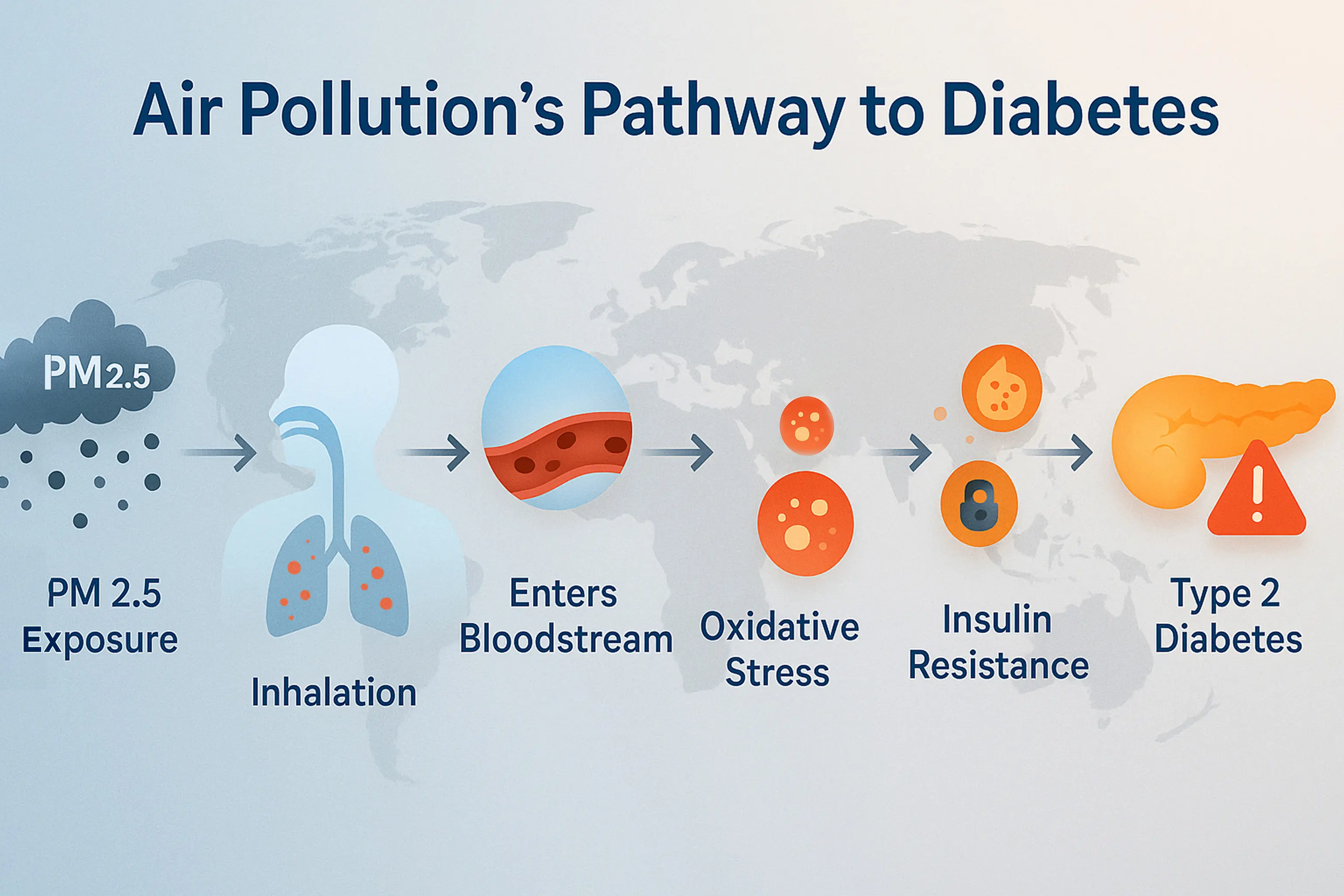
According to the Health Effects Institute’s 2024 State of Global Air report, 18% of diabetes deaths worldwide in 2021 attributed to outdoor air pollution, underscoring the urgent need to address air quality in regions with high pollution levels. While these percentages vary across countries, the evidence clearly points to air pollution as a significant, and growing, contributor to diabetes mortality.
Geographic Distribution of Outdoor Air Pollution Contributes to Rising Diabetes Mortality
The impact of outdoor air pollution on diabetes-related deaths is not evenly distributed across the globe. The regions most affected are typically those with high industrial activity, dense populations, and inadequate air quality regulations. As a result, countries with severe air pollution problems are facing a double burden on public health—rising rates of diabetes and increasing pollution-related deaths.
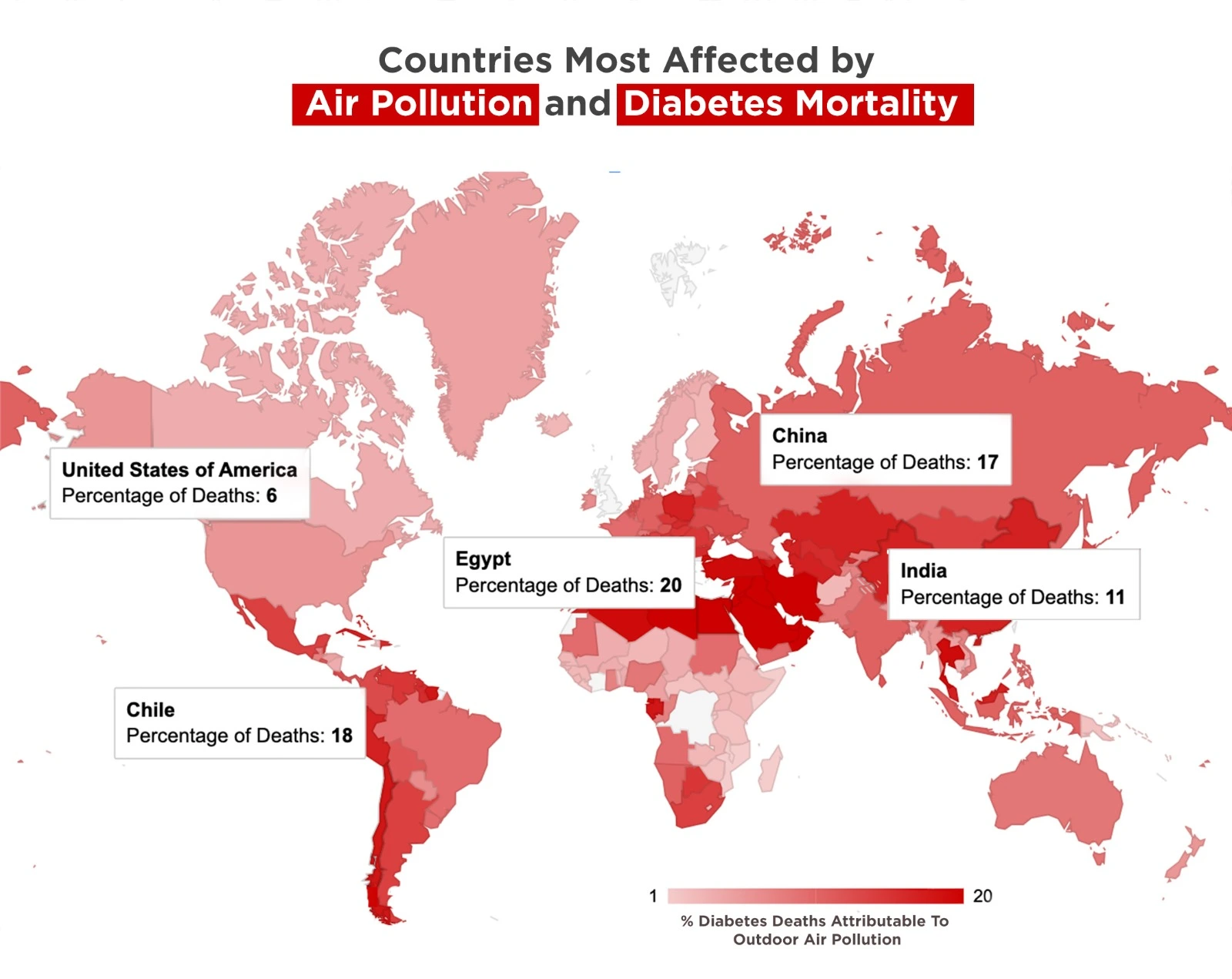
In countries where air pollution is high—such as parts of the Middle East, South Asia, and East Asia—the percentage of diabetes deaths attributed to outdoor fine particles is alarmingly high. For instance:
- Oman, Qatar, Saudi Arabia, Jordan, Iran, Iraq, and Kuwait each report that 20% of diabetes deaths are attributable to outdoor air pollution.
- Thailand and Tunisia follow closely with 19% of diabetes deaths linked to air pollution.
These figures underscore the need for urgent action in regions where both diabetes and pollution are major health concerns. The combination of poor air quality and high diabetes prevalence exacerbates the risks to public health, creating a severe and avoidable burden on healthcare systems.
A Call for Action in Regions with Lower Air Pollution
In contrast, regions with more stringent environmental regulations, better air quality management, and lower levels of industrialisation tend to report lower percentages of diabetes deaths due to air pollution. Countries in Europe and North America, for instance, typically see diabetes-related deaths due to pollution in the range of 5% to 12%. However, even in these regions, outdoor air pollution contributes to rising diabetes mortality, reminding us that no region is immune to the dangers of poor air quality.
Countries like France, Germany, and the Netherlands show that even in relatively cleaner regions, air pollution remains a significant factor in exacerbating diabetes mortality. This calls for a continuous commitment to improving air quality, even in areas where pollution levels are lower.
Why Does the Geographic Distribution of Diabetes Mortality Matter?
Understanding the geographic distribution of diabetes mortality due to air pollution is vital for directing resources and efforts where they are needed most. Countries experiencing high rates of pollution-related diabetes deaths need to prioritise air quality improvements and diabetes management programs to mitigate this double burden on public health. Addressing air pollution could prevent a significant number of diabetes-related deaths, making it an urgent priority for policymakers.
By improving air quality in these high-risk regions, governments can reduce the health burden on populations, prevent future cases of diabetes, and ultimately improve the overall quality of life for millions of people.
Countries Most Affected by Air Pollution and Diabetes Mortality
The global data clearly shows that certain countries are disproportionately affected by outdoor air pollution contributes to rising diabetes mortality. Here is a snapshot of some of the countries most impacted by this dual threat, with the highest percentages of diabetes deaths attributed to outdoor air pollution:
These countries face a unique and critical challenge, with significant portions of diabetes-related deaths linked directly to outdoor air pollution. To address this, there is an urgent need for stronger environmental policies, improved diabetes management strategies, and collaborative global efforts to reduce emissions. Data Source (UNEP)
| Sl.No. | Country | % Diabetes Deaths Attributable To Outdoor Air Pollution |
| 1 | Rep. of Korea | 20 |
| 2 | Islamic Rep. of Iran | 20 |
| 3 | Iraq | 20 |
| 4 | Syrian Arab Rep. | 20 |
| 5 | Saudi Arabia | 20 |
| 6 | Bahrain | 20 |
| 7 | Egypt | 20 |
| 8 | Jordan | 20 |
| 9 | Kuwait | 20 |
| 10 | Libya | 20 |
| 11 | United Arab Emirates | 20 |
| 12 | Oman | 20 |
| 13 | Qatar | 20 |
| 14 | Barbados | 19 |
| 15 | Türkiye | 19 |
| 16 | Armenia | 19 |
| 17 | Algeria | 19 |
| 18 | Thailand | 19 |
| 19 | Tunisia | 19 |
| 20 | State of Palestine | 19 |
| 21 | Equatorial Guinea | 19 |
| 22 | Saint Lucia | 18 |
| 23 | Saint Vincent and the Grenadines | 18 |
| 24 | Grenada | 18 |
| 25 | Lebanon | 18 |
| 26 | Trinidad and Tobago | 18 |
| 27 | Israel | 18 |
| 28 | Suriname | 18 |
| 29 | Gabon | 18 |
| 30 | Chile | 18 |
| 31 | Poland | 17 |
| 32 | Antigua and Barbuda | 17 |
| 33 | Cuba | 17 |
| 34 | Kazakhstan | 17 |
| 35 | Serbia | 17 |
| 36 | Azerbaijan | 17 |
| 37 | North Macedonia | 17 |
| 38 | China | 17 |
| 39 | Turkmenistan | 17 |
| 40 | Morocco | 17 |
| 41 | Malaysia | 17 |
| 42 | Peru | 17 |
| 43 | Slovakia | 16 |
| 44 | Bahamas | 16 |
| 45 | Bulgaria | 16 |
| 46 | Dominican Rep. | 16 |
| 47 | Uzbekistan | 16 |
| 48 | Dominica | 16 |
| 49 | Cyprus | 16 |
| 50 | Guyana | 16 |
| 51 | Ecuador | 16 |
| 52 | Singapore | 16 |
| 53 | Belarus | 15 |
| 54 | Czechia | 15 |
| 55 | Hungary | 15 |
| 56 | Romania | 15 |
| 57 | Slovenia | 15 |
| 58 | Belize | 15 |
| 59 | Croatia | 15 |
| 60 | Bosnia and Herzegovina | 15 |
| 61 | Montenegro | 15 |
| 62 | Bhutan | 15 |
| 63 | Cabo Verde | 15 |
| 64 | Venezuela | 15 |
| 65 | Botswana | 15 |
| 66 | Mexico | 14 |
| 67 | Italy | 14 |
| 68 | Mongolia | 14 |
| 69 | Argentina | 14 |
| 70 | South Africa | 14 |
| 71 | Ukraine | 13 |
| 72 | Japan | 13 |
| 73 | Georgia | 13 |
| 74 | Malta | 13 |
| 75 | Jamaica | 13 |
| 76 | Albania | 13 |
| 77 | Costa Rica | 13 |
| 78 | Colombia | 13 |
| 79 | Latvia | 12 |
| 80 | Netherlands | 12 |
| 81 | Belgium | 12 |
| 82 | Austria | 12 |
| 83 | El Salvador | 12 |
| 84 | Panama | 12 |
| 85 | Sri Lanka | 12 |
| 86 | Bolivia | 12 |
| 87 | Djibouti | 12 |
| 88 | Maldives | 12 |
| 89 | Germany | 11 |
| 90 | Russian Fed. | 11 |
| 91 | San Marino | 11 |
| 92 | India | 11 |
| 93 | Indonesia | 11 |
| 94 | Namibia | 11 |
| 95 | Lithuania | 10 |
| 96 | Denmark | 10 |
| 97 | France | 10 |
| 98 | Rep. of Moldova | 10 |
| 99 | Mauritania | 10 |
| 100 | Philippines | 10 |
| 101 | Sudan | 10 |
| 102 | Yemen | 10 |
| 103 | Brazil | 10 |
| 104 | Guam | 10 |
| 105 | Uruguay | 10 |
| 106 | Angola | 10 |
| 107 | Eswatini | 10 |
| 108 | Switzerland | 9 |
| 109 | Spain | 9 |
| 110 | Pakistan | 9 |
| 111 | Nigeria | 9 |
| 112 | Seychelles | 9 |
| 113 | Australia | 9 |
| 114 | Mauritius | 9 |
| 115 | Luxembourg | 8 |
| 116 | Guatemala | 8 |
| 117 | Kyrgyzstan | 8 |
| 118 | Tajikistan | 8 |
| 119 | Viet Nam | 8 |
| 120 | Ghana | 8 |
| 121 | Congo | 8 |
| 122 | Fiji | 8 |
| 123 | Ireland | 7 |
| 124 | Portugal | 7 |
| 125 | Saint Kitts and Nevis | 7 |
| 126 | United States Virgin Islands | 7 |
| 127 | Brunei Darussalam | 7 |
| 128 | Palau | 7 |
| 129 | Paraguay | 7 |
| 130 | United States of America | 6 |
| 131 | Bermuda | 6 |
| 132 | Myanmar | 6 |
| 133 | Nepal | 6 |
| 134 | New Zealand | 6 |
| 135 | Estonia | 5 |
| 136 | Greenland | 5 |
| 137 | Honduras | 5 |
| 138 | Lao People’s Dem. Rep. | 5 |
| 139 | Cameroon | 5 |
| 140 | Tokelau | 5 |
| 141 | Sao Tome and Principe | 5 |
| 142 | Timor-Leste | 5 |
| 143 | American Samoa | 5 |
| 144 | Niue | 5 |
| 145 | Sweden | 4 |
| 146 | Norway | 4 |
| 147 | Canada | 4 |
| 148 | Nicaragua | 4 |
| 149 | Bangladesh | 4 |
| 150 | Gambia | 4 |
| 151 | Burkina Faso | 4 |
| 152 | Mali | 4 |
| 153 | Benin | 4 |
| 154 | Chad | 4 |
| 155 | Nauru | 4 |
| 156 | Tonga | 4 |
| 157 | Finland | 3 |
| 158 | Iceland | 3 |
| 159 | Afghanistan | 3 |
| 160 | Cambodia | 3 |
| 161 | Senegal | 3 |
| 162 | Eritrea | 3 |
| 163 | Guinea | 3 |
| 164 | Guinea-Bissau | 3 |
| 165 | Niger | 3 |
| 166 | Sierra Leone | 3 |
| 167 | South Sudan | 3 |
| 168 | Togo | 3 |
| 169 | Ethiopia | 3 |
| 170 | Fed. States of Micronesia | 3 |
| 171 | Marshall Islands | 3 |
| 172 | Uganda | 3 |
| 173 | Kenya | 3 |
| 174 | Samoa | 3 |
| 175 | Zambia | 3 |
| 176 | Lesotho | 3 |
| 177 | Haiti | 2 |
| 178 | Dem. People’s Rep. of Korea | 2 |
| 179 | Central African Rep. | 2 |
| 180 | Liberia | 2 |
| 181 | Papua New Guinea | 2 |
| 182 | Rwanda | 2 |
| 183 | United Rep. of Tanzania | 2 |
| 184 | Zimbabwe | 2 |
| 185 | Somalia | 1 |
| 186 | Tuvalu | 1 |
| 187 | Kiribati | 1 |
| 188 | Burundi | 1 |
| 189 | Comoros | 1 |
| 190 | Malawi | 1 |
| 191 | Solomon Islands | 1 |
| 192 | Madagascar | 1 |
| 193 | Mozambique | 1 |
| 194 | Vanuatu | 1 |
Strategies to Reduce Diabetes Mortality Due to Air Pollution
While reducing diabetes mortality due to outdoor air pollution is a global challenge, several strategies can help mitigate the effects of air pollution and reduce the burden of diabetes. Here are some key strategies:
- Stricter Environmental Regulations: Governments must implement and enforce stricter air quality regulations to limit industrial emissions, reduce vehicular pollution, and control agricultural activities that contribute to particulate matter in the air. Policies that prioritise cleaner energy sources, such as solar and wind, can help reduce the amount of air pollution.
- Urban Planning and Green Spaces: In rapidly growing urban areas, it is essential to integrate green spaces and promote public transportation to reduce air pollution from traffic. Urban planning that prioritises green spaces and the use of electric vehicles can help reduce the harmful effects of PM2.5.
- Public Awareness and Health Education: Public health campaigns that raise awareness about the link between air pollution and diabetes are essential. Educating people on how to reduce their exposure to air pollution, such as staying indoors during high pollution events or using air purifiers, can help mitigate the health impacts.
- International Cooperation: Air pollution is a global problem that requires international cooperation to solve. Collaborative efforts to address transboundary air pollution and share best practices for reducing emissions can help improve air quality on a global scale.
- Health Infrastructure: Strengthening healthcare systems to address the dual burden of diabetes and air pollution is crucial. Healthcare providers should be equipped with the tools and knowledge to educate patients about the risks of air pollution and its role in diabetes progression.
Conclusion: The Urgency of Addressing Air Pollution and Diabetes
The data paints a clear picture—outdoor air pollution mainly contributes to rising diabetes mortality, and the regions most affected are those with the highest pollution levels and growing industrialization. To tackle this issue, governments must prioritize cleaner air and healthier environments, implement stricter regulations, and invest in sustainable practices.
As individuals, we can also contribute by advocating for policies that reduce air pollution and supporting actions that protect public health. Only through collective effort can we begin to curb the devastating effects of air pollution on diabetes and create a healthier, more sustainable world for future generations.
 Deepshikha