 Poorna Khanna
We come across the phrase ‘smart city’ a lot nowadays. How can a city be smart? What are the attributes of a smart city? What is the importance of air quality monitoring? How will the air quality monitoring in a smart city appear? Read more to find out.
The emerging need for transition
Cities hold the key to urbanization. They are the fuel that drives the engine of the economy and development of any nation. A considerable share in the GDP comes from the cities, especially in developing countries such as India, where the urban population contributes 63% of the GDP (Census, 2011). This share will increase to 75% by 2030. Some recent studies project a rise in the population dwelling in the cities from 31% to 60%. This paradigm shift requires the parallel development of physical, social, economic, and institutional infrastructure. It is necessary to attract people and sustain the increasing density and complement the advancements in technology.
What is a smart city?
The transition of traditional cities into smart cities was gradual. The idea of smart cities did not emerge until the late 1990s. The concept is still evolving. There is no concrete way to limit it into a definition. A smart city is a technology-intensive urban area that integrates Information and Communication Technology (ICT) into the city’s governance and management system. It ensures transparent, secure, and efficient public services. A smart city is connected by a self-reliant network of Internet of Things (IoT) to collect, process, and analyze data. Sensors are installed into real-time monitoring systems to create an uninterrupted and direct flow of information between the officials and the community. This interaction is vital for a better quality of life and efficient monitoring.
Elements of a Smart City?
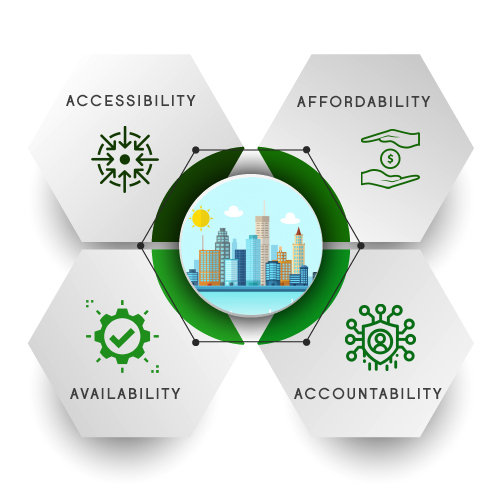
A smart city is both inclusive and conservatory in nature. It increases the liveability quotient and happiness index of a city. The concept of a smart city revolves around four As:
- Availability
- Accessibility
- Affordability
- Accountability
The core elements of a smart city are:
- Smart Citizen
- Green Buildings
- Sustainable Infrastructure
- Smart Health Care
- E-Governance
- Smart Technology
- Clean and Smart Energy
- Smart Education
- Smart Mobility
The prime structure of a smart city plan would include-
- Adequate Water Supply
- Clean and breathable air
- 24*7 supply of clean energy
- Efficient waste management system
- Efficient urban mobility and public transport
- Affordable housing
- Robust connectivity and digitization
- Sustainable Environment
- Safety and Security of all citizens
- Just and transparent judicial system
- Accessible health and educational services
- Good governance
- Public-Private Partnership (PPP) models
Importance of Air Quality Monitoring in a Smart City
Air is an invisible elixir to live on the planet. We cannot see it, but it is crucial to us living creatures. Thus, it is indispensable that what we breathe is free from pollutants. Provided the increasing urbanization, the problem of air pollution prevails as one of the top troublemakers. Severe Air Quality has a conspicuous influence on morbidity and mortality. It also affects the environment and ecology adversely. For this reason, agencies cite air pollution as one of the major killers on the earth. As per the World Health Organization, air pollution kills an estimated seven million people worldwide every year. 9 out of 10 people breathe air that exceeds the limits set by the organization.
Air Quality Forecasting, monitoring, and maintenance are chief aspects of a smart city model. Real-time analysis of indoor and outdoor contaminants of air ensures that we are aware of what we are inhaling. It also enables the researchers to do immediate data analysis and help the policy-makers to draft an efficient action plan to mitigate the negative impact.
How we envision Smart Air Quality Monitoring
Our prime objective is to provide cost-effective access to air quality data to every citizen of the city, integrated with an accountable solution-mapping ability.
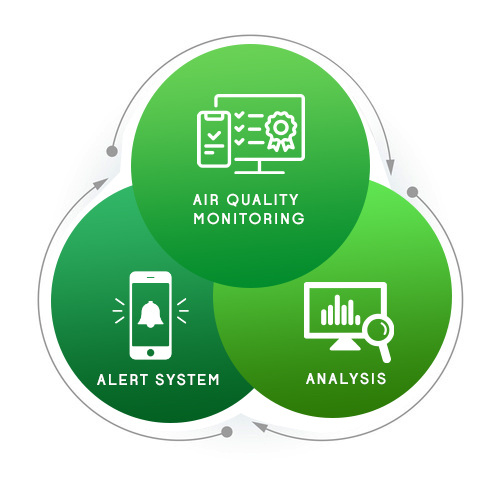
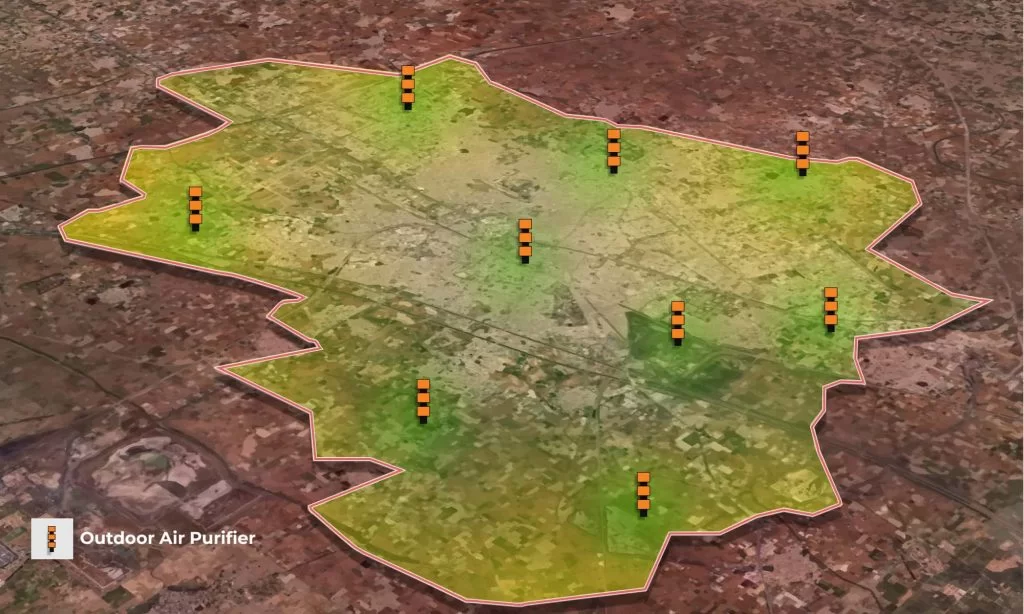
Power and communication will lay the foundation of the monitoring network. The citizens of a smart city shall remain informed and engaged about the air quality via a dense network of monitors lodged with high-efficiency microsensors. A centralized dashboard will make this data extremely accessible. A concurrent analysis as per regulatory standards set by the central environmental agency/authority will also take place. GPS will enable the server to map out the air pollution data obtained from the mounting points. An alert system will subsequently notify the user with a health advisory and pollution hotspots of the city.
Thus, our air monitoring system will infuse an intelligent cycle based on- air quality monitoring, analysis of data, and mitigation through an alert system.
Our vision can be integrated into all the aspects of the city management (indoor as well as outdoor) to provide a holistic approach to air quality problems. Imagine a portable device with the capabilities of an entire air monitoring station mounted on a wall! Now imagine a well-connected network of such monitors that can not only forecast but also warn you if the air gets polluted, and provide you with health advice! Wouldn’t it be revolutionary for the domain of air quality monitoring in a smart city?
Prana Air Smart City Project | Air Quality Monitoring & Fresh Air Machine
 To check out our range of air quality monitors, visit the website.
Also know more about air quality solutions for Smart City Projects.

 Gyane Haobijam
 Shikha Sharma