

















Air pollution remained a critical global health challenge in 2025, with vast differences in exposure levels across regions. Using AQI.IN’s city-level AQI data, country-level yearly AQI averages, and PM2.5 concentration benchmarks aligned with WHO guidelines, this report presents a comprehensive picture of global air quality.
Global Overview: What the Data Reveals
- Only 14.89% of monitored cities worldwide meet the WHO PM2.5 guideline of 5 µg/m³
- Asia hosts the largest number of polluted cities and the lowest compliance rate
- Oceania and North America lead in clean air performance
- PM2.5 exposure remains the most critical risk factor for long-term health impacts
Continental Air Quality Assessment Based on City AQI (2025)
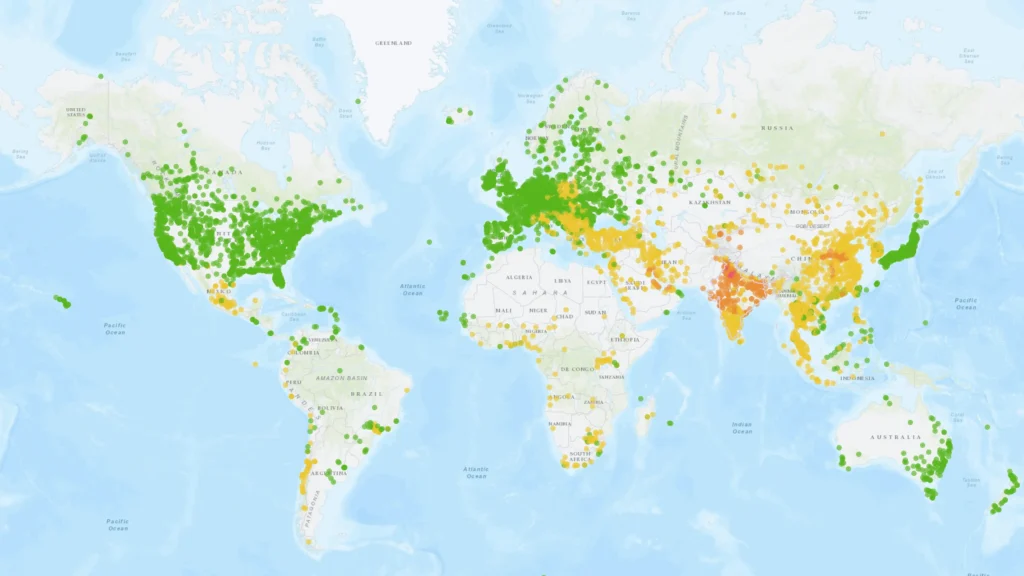
City-level AQI classifications reveal how pollution affects populations at the ground level.
- Asia is the only continent where cities fall into Poor and Unhealthy categories
- Europe, North America, and Oceania record zero cities in severe AQI categories
- Africa and South America remain largely within Moderate AQI ranges
This uneven distribution highlights the growing air quality divide between regions.
PM2.5 Exposure: WHO Guideline Compliance by Continent
Fine particulate matter (PM2.5) poses the greatest health risk, penetrating deep into the lungs and bloodstream. The WHO guideline of 5 µg/m³ represents the threshold for long-term safety.
PM2.5 Compliance Summary (City Level)
| Continent | Total Cities | Cities ≤ 5 µg/m³ | % Within WHO |
|---|---|---|---|
| Africa | 134 | 2 | 1.49% |
| Asia | 2223 | 12 | 0.54% |
| Europe | 2330 | 288 | 12.36% |
| North America | 2,001 | 610 | 30.48% |
| Oceania | 157 | 124 | 79.11% |
| South America | 128 | 2 | 1.56% |
| Global | 6,973 | 1,038 | 14.89% |
Key PM2.5 Insights
- Asia has the lowest WHO compliance rate globally, with just 0.51% of cities meeting safe PM2.5 levels
- Oceania leads decisively, with nearly 4 out of 5 cities within WHO limits
- North America performs strongly, with almost one-third of cities meeting safe thresholds
- Africa and South America show widespread exposure, despite fewer extreme AQI events
This demonstrates that even regions with “Moderate” AQI often fail to meet safe PM2.5 standards.
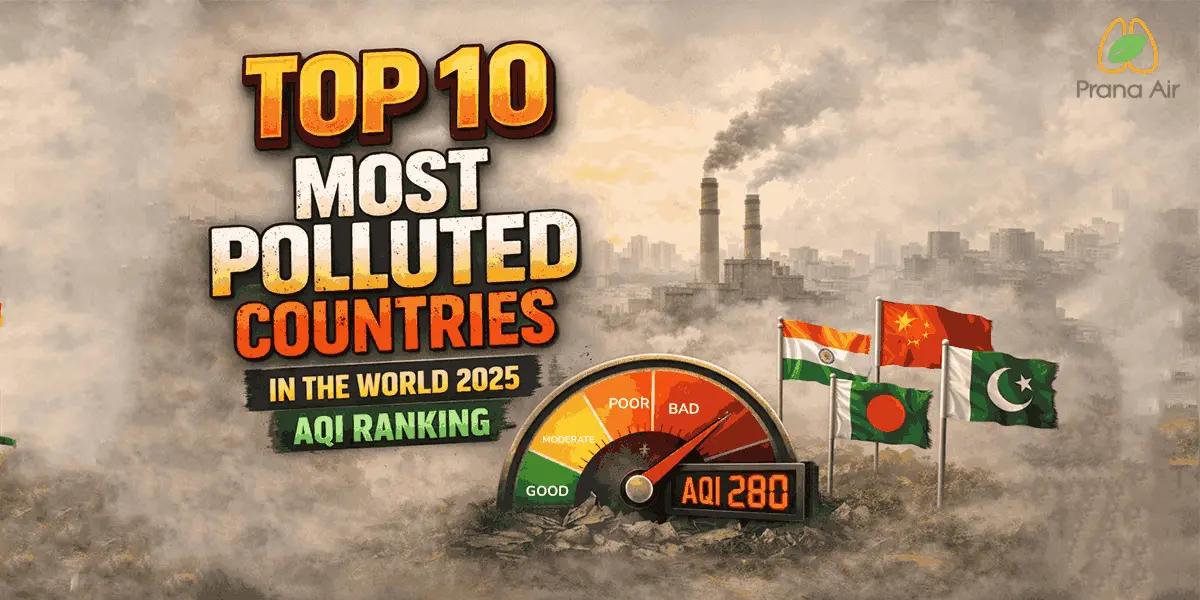
Most Polluted Countries in World 2025 (Yearly Avg. AQI)
- Bangladesh – 114
- India – 111
- Pakistan – 110
- Bahrain – 104
- Kuwait – 96
- UAE – 95
- Tajikistan – 92
- Nepal – 84
- Qatar – 82
- Saudi Arabia / China – 80
Data Source: www.aqi.in
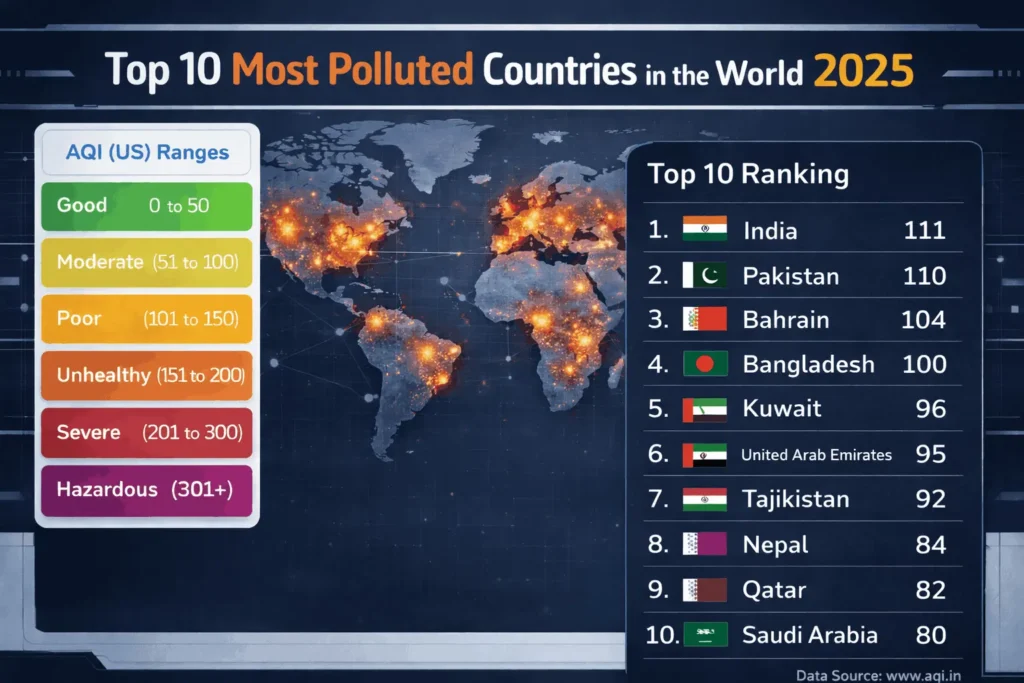
These countries experience sustained exposure to harmful particulate matter driven by urbanisation, industrial emissions, traffic congestion, fossil fuel use, and regional dust events.
Country-Wise Air Quality Analysis – 2025
1. Bangladesh (Average AQI: 114)
Bangladesh ranked as the most polluted country in 2025. Its air quality remained consistently poor, with dense urbanisation and brick kilns, vehicular emissions, construction dust, and transboundary pollution contributing to elevated PM2.5 levels. Seasonal improvements during the monsoon were insufficient to offset extreme pollution episodes during winter, keeping the national average at the threshold of severe health concern.
2. India (Average AQI: 111)
India ranked as the most polluted country in 2025, with air quality remaining consistently in the “Poor” category for much of the year. Major metropolitan regions in northern and central India experienced prolonged winter smog driven by PM2.5 emissions, vehicular pollution, industrial activity, biomass burning, and adverse meteorological conditions. Despite periodic improvements during the monsoon months, pollution levels rebounded sharply in Q4, pushing the national average to the top of the global ranking.
3. Pakistan (Average AQI: 110)
Pakistan closely followed India, reflecting severe and persistent urban air pollution across its major cities. Winter temperature inversions, industrial emissions, traffic congestion, brick kilns, and agricultural residue burning significantly elevated PM2.5 concentrations. Air quality remained poor for extended periods, particularly in densely populated urban centres, placing Pakistan firmly in the high-risk exposure category in 2025.
4. Bahrain (Average AQI: 104)
Bahrain recorded poor air quality throughout much of the year, largely influenced by industrial emissions, oil-related activities, traffic density, and regional dust events. Limited urban dispersion due to climatic conditions further intensified pollution levels, resulting in one of the highest average AQI values in the Middle East in 2025.
5. Kuwait (Average AQI: 96)
Kuwait’s air pollution in 2025 was shaped by a combination of desert dust storms, oil and gas operations, industrial emissions, and urban traffic. While not reaching the extreme levels seen in South Asia, prolonged exposure to particulate matter placed Kuwait among the most polluted countries globally, particularly during dry and windy periods.
6. United Arab Emirates (Average AQI: 95)
The UAE experienced moderate to unhealthy air quality across several urban regions in 2025. Construction activity, vehicular emissions, industrial operations, and frequent dust events were the primary contributors. Although air quality management and infrastructure remain relatively advanced, environmental and climatic factors continued to push average AQI values above healthy limits.
7. Tajikistan (Average AQI: 92)
Tajikistan’s elevated AQI levels were influenced by urban emissions, industrial sources, limited pollution control infrastructure, and regional dust transport. Seasonal heating and geographical constraints further worsened air stagnation, resulting in sustained exposure to unhealthy air conditions in several cities.
8. Nepal (Average AQI: 84)
Nepal recorded moderate to unhealthy air quality, especially in urban valleys where vehicular emissions, biomass burning, construction dust, and topographical trapping of pollutants significantly affected air circulation. While pollution levels were lower than neighbouring South Asian countries, they remained above safe limits for much of 2025.
9. Qatar (Average AQI: 82)
Qatar’s air quality challenges in 2025 were primarily driven by industrial activity, traffic emissions, and frequent dust events. Although population density is relatively low, climatic conditions and regional pollution transport contributed to elevated particulate matter concentrations throughout the year.
10. Saudi Arabia (Average AQI: 80)
Saudi Arabia completed the top ten list with moderate to unhealthy air quality levels. Key contributors included desert dust, large-scale industrial operations, urban expansion, and vehicular emissions. While pollution intensity varied seasonally, sustained exposure kept annual averages above recommended health thresholds.
Regional Highlights
Asia: Global Pollution Epicentre
Asia dominates high-AQI rankings and records the lowest PM2.5 safety compliance worldwide. Rapid economic growth, population density, and reliance on fossil fuels continue to push air quality beyond safe limits.
Africa & South America: Moderate but Vulnerable
While extreme AQI values are rare, over 98% of cities fail WHO PM2.5 guidelines, indicating chronic exposure risks that often go unnoticed.
Europe: Strong Regulation, Gradual Progress
Europe shows solid performance, yet only 12% of cities meet WHO PM2.5 limits—highlighting the gap between regulatory compliance and health-based standards.
North America: Balanced but Uneven
With 30% of cities within safe PM2.5 limits, North America performs well globally, though urban traffic and wildfire events remain key challenges.
Oceania: Global Benchmark for Clean Air
Oceania stands out as the cleanest continent, both in AQI and PM2.5 compliance, reflecting effective environmental governance and lower population density.
Conclusion: A Global Call for Clean Air Action
The World’s Most Polluted Countries in 2025 analysis reveals a stark global divide. While some regions move closer to clean air goals, large parts of the world remain dangerously exposed—often far beyond safe limits.


 Let’s Talk