 Anwesha
Understanding how an AQI monitor works has become increasingly important as air pollution affects daily life in India. PM2.5, gases and humidity levels change constantly inside homes and workplaces. Prana Air’s monitoring devices help users see these changes by turning invisible pollutants into clear information. To understand how these devices deliver accurate readings, it helps to explore the sensors, internal processing and calibration behind them.
1. Sensors: The foundation of accurate air measurement
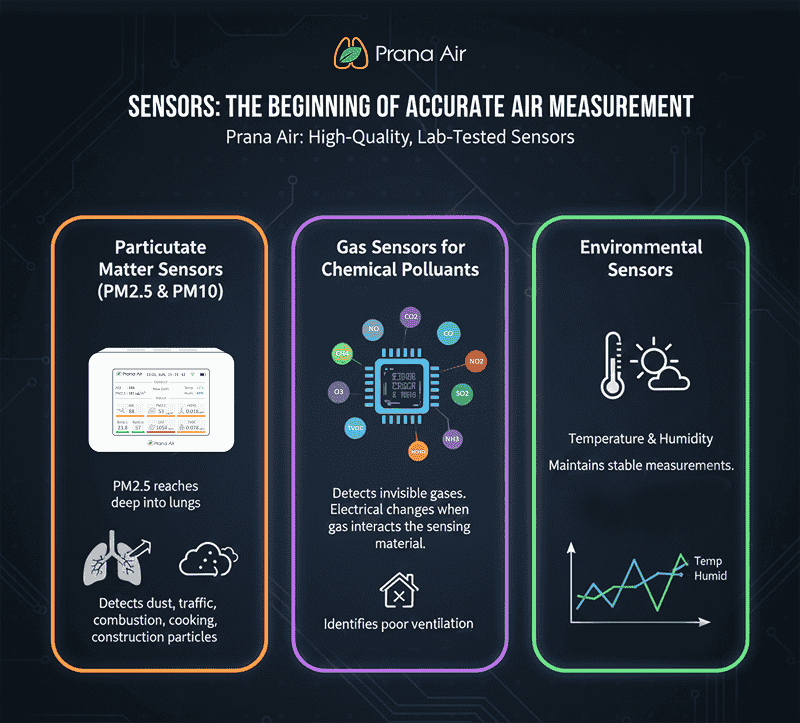
Reliable air quality monitoring begins with sensors. These components detect pollutants, environmental conditions and chemical activity in the air. Prana Air uses high-quality sensors designed to perform well across Indian climatic conditions.
Particulate matter sensors
Devices such as the Pocket PM2.5 Monitor, Cair Plus and Sensible use light-based technology to measure PM2.5 and PM10. These particles originate from dust, traffic, construction, cooking and combustion. PM2.5 is especially harmful because it can reach deep inside the lungs.
Inside the device, air enters a sensing chamber where a beam of light illuminates the particles. As particles move through the beam, they scatter light. A detector measures this scattering pattern and the device calculates particulate concentration from this interaction. This method offers dependable real-time detection.
Gas and chemical sensors
Indoor spaces often contain gases that are not visible. Prana Air monitors detect CO₂, TVOCs, formaldehyde, CO and in advanced models gases such as NO₂, SO₂ and O₃. These sensors work by generating electrical signals when gas molecules interact with the sensing surface. The monitor interprets these signals to determine gas concentration.
Environmental sensors
Temperature and humidity influence how sensors behave. Prana Air includes environmental sensors to maintain stable and accurate readings across different seasons and conditions.
2. Turning measurements into meaningful information
Learning how an AQI monitor works also means understanding how raw sensor readings become usable data. Sensors generate electrical signals that cannot be interpreted directly. Prana Air’s internal system converts these signals into pollutant concentrations that accurately reflect what is present in the air.
The device begins by converting electrical outputs into standard scientific units. For particulate matter, readings become micrograms per cubic meter. For gases, values are expressed in parts per million or parts per billion. These conversions follow calibration curves developed through controlled laboratory and field testing.
Environmental factors such as temperature and humidity are included in the calculation because they influence sensor behaviour. By accounting for these conditions, the monitor maintains stable measurements across different indoor environments and seasons.
Once pollutant concentrations are ready, the device applies the CPCB AQI formula to determine the final AQI number. Each pollutant is translated into a sub-index and the highest value becomes the overall AQI displayed. In most Indian settings, PM2.5 is usually the pollutant that drives this number.
This entire process ensures that the readings shown on a Prana Air monitor are clear, reliable and representative of real-time air quality.
3. Calibration: Ensuring accuracy over time
Calibration is important because sensors naturally shift with time and environmental exposure. Prana Air maintains accuracy through several calibration steps.
Factory calibration
Each sensor is calibrated against reference-grade instruments before it is installed in a device. This creates a consistent accuracy baseline.
Environmental adjustments during use
As the device is used, it experiences changes in temperature, humidity and airflow. Prana Air’s firmware includes correction mechanisms that help maintain stable readings without affecting the real-time nature of the measurements.
Field calibration for advanced applications
For research, industrial use or smart city deployments, Prana Air supports field calibration. Devices can be compared with reference stations or laboratory samplers to achieve high precision when required.
4. Connectivity: Making air quality information accessible
Prana Air devices offer convenient access to air quality data. With Wi-Fi, GSM and RS-485 connectivity, users can view real-time pollutant levels and long-term trends through the AQI Dashboard and the AQI Mobile App. These platforms display information in a clear and simple format, allowing users to understand how air quality changes throughout the day. RS-485 support also makes it easy to integrate monitors into building management systems and industrial setups. By checking air quality through the AQI Dashboard or the AQI Mobile App, users can make informed decisions and create healthier indoor environments.

Conclusion
Understanding how an AQI monitor works reveals the technology behind the air quality number shown on a device. Prana Air combines precise sensors, intelligent data processing and reliable calibration to deliver accurate real-time insights. Whether used in a home, office, school or large-scale environmental project, these monitors turn invisible pollutants into meaningful information.
By measuring, analysing and presenting air quality clearly, Prana Air helps users make better decisions about the air they breathe.

 Gyane Haobijam