 Gyane Haobijam
Nobody talks about AC filters until something goes wrong. The cooling drops. The unit starts making a strange sound. A musty smell fills the room the moment you switch it on. By the time most people open the front panel and actually look at the filter, it has been quietly failing for months.
That filter — that thin, easy-to-ignore piece of mesh — is doing more for your home than you probably give it credit for. And when it stops doing its job, the consequences show up in your electricity bill, your health, and eventually your AC unit itself.
Here is what a good AC filter is actually doing for you, and what life looks like without it.
It Is Keeping the Air in Your Room Cleaner Than You Realise
Every time your AC runs, it pulls room air through the indoor unit, cools it, and pushes it back out. That air carries whatever is floating in your room — dust, pollen, pet dander, mold spores, fine particulate matter. Without a filter sitting in that airflow path, all of it goes straight into the machine and straight back into the room on the next cycle.
A functioning AC filter intercepts that load before it recirculates. Dust gets trapped. Pollen gets caught. The larger debris that would otherwise keep bouncing around your room every time the fan kicks on stays locked in the filter media instead.
This matters more than people think. Most of us spend eight or more hours in our bedrooms with the AC running. That is eight hours of continuous air circulation — either through a filter that is doing its job, or through one that is not. The difference in what you are inhaling across a full night is not trivial.
In Indian cities especially, where outdoor PM2.5 levels push indoor air quality down even in closed rooms, a properly maintained AC filter is one of the most practical first lines of defence available inside any home.
It Protects Your Machine — and Your Energy Bill Along With It
This is the function manufacturers designed AC filters for in the first place. Dust and debris that bypass the filter settle directly onto the evaporator coil — the component responsible for actually cooling the air. A coated coil cannot transfer heat efficiently. The machine has to work harder, run longer, and draw more power just to reach the same temperature.
A clean, functioning filter keeps that coil clear. The AC runs at the efficiency it was designed for. Cooling is faster. Power consumption stays in check.
According to energy studies on HVAC performance, a clogged or absent filter can increase an AC unit’s energy consumption by 5 to 15 percent. Over a full Indian summer — where units often run 10 to 12 hours a day for months — that adds up to a meaningful difference on your electricity bill without you ever noticing why.
It Reduces Allergens and Protects Respiratory Health
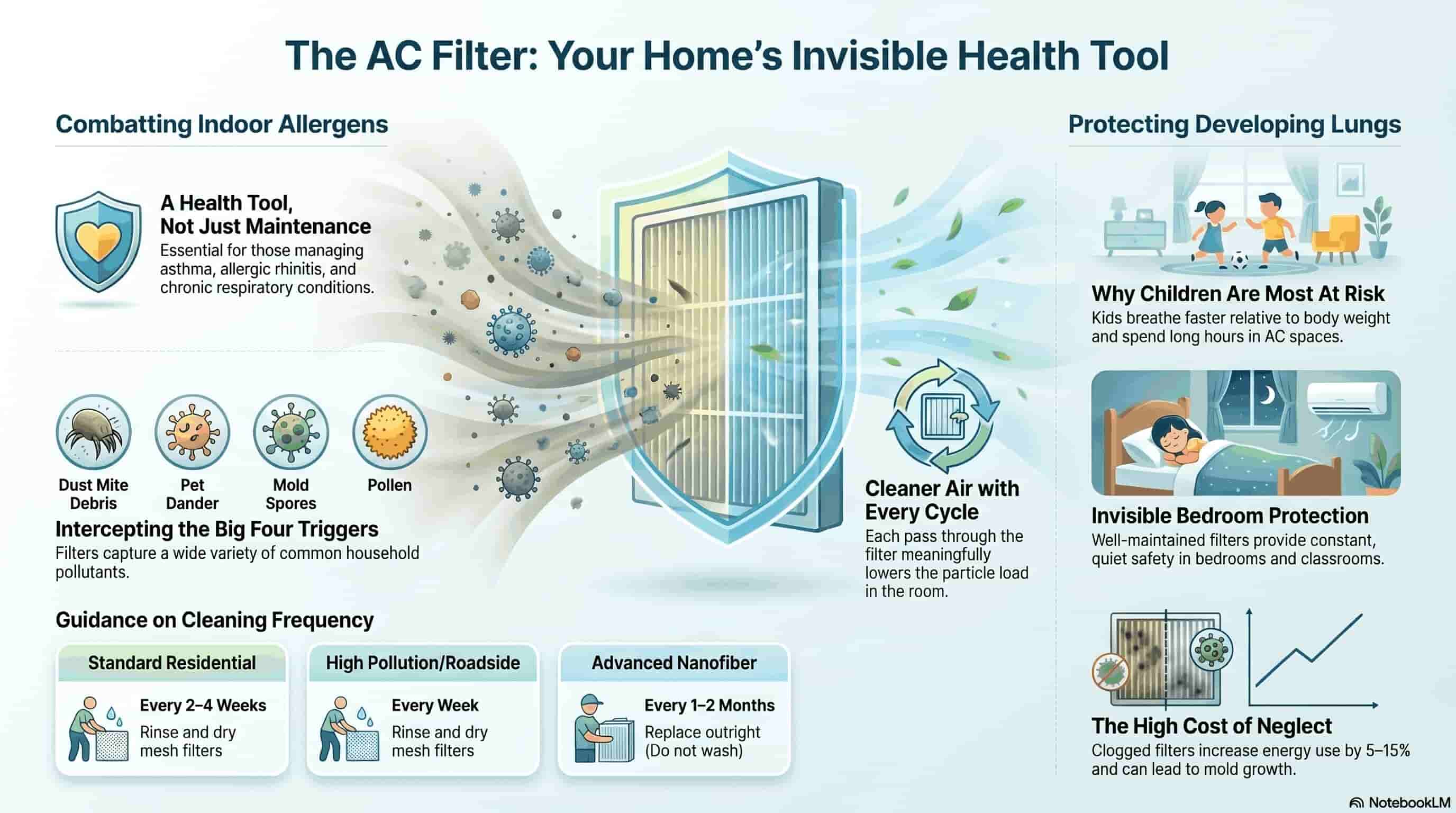
If anyone in your home deals with asthma, allergic rhinitis, dust allergies, or any chronic respiratory condition, the AC filter is not a maintenance item. It is a health tool.
Dust mite debris, pet dander, mold spores, and pollen — the most common indoor allergen triggers — are all in the size range that a quality AC filter can intercept. Every time the AC cycles, air passes through the filter and comes out carrying a lower load of these particles. Over the course of a day, that adds up to meaningfully cleaner air for the people breathing it.
Children are particularly affected. Their lungs are still developing, they breathe faster relative to their body weight, and they tend to spend long hours in air-conditioned bedrooms and classrooms. A well-maintained filter in those spaces is quiet, invisible protection that costs almost nothing to provide.
It Controls Dust Accumulation Around the Room
Here is something most people notice without connecting to the AC filter: when the filter is clean, surfaces around the room stay cleaner for longer. When the filter is clogged or missing, dust settles on furniture, shelves, and electronics faster than usual.
That is not a coincidence. A filter that is saturated stops catching dust and starts releasing what it has already caught. Every cycle of the fan dislodges particles from the overloaded filter and redistributes them around the room. You end up cleaning more often, and wondering why the room never quite feels fresh — even with the AC running all day.
A functioning filter keeps that circulation loop cleaner. The room does not just feel cooler. It stays noticeably cleaner between cleans.
It Prevents Mold Growth Inside the Unit
AC units generate condensation as part of the cooling process. The interior of the indoor unit — particularly around the evaporator coil and the drain pan — stays damp during operation. That warm, moist environment is ideal for mold growth.
A clean filter stops dust and organic particles from settling in that environment and feeding mold colonies. A clogged or absent filter allows exactly that to happen. Once mold establishes itself inside the unit, the AC starts blowing mold spores directly into the room every time it runs. That musty smell people notice when they switch on an AC they have not used in a while is often this — not old air, but active mold being distributed through the room.
Cleaning or replacing the filter regularly is the simplest way to prevent this from happening. Far cheaper than a full internal clean of the unit, and far better for the health of everyone in the room.
What Happens Without a Filter — or With One That Has Given Up
Run your AC without a functioning filter, and within weeks the effects start stacking up.
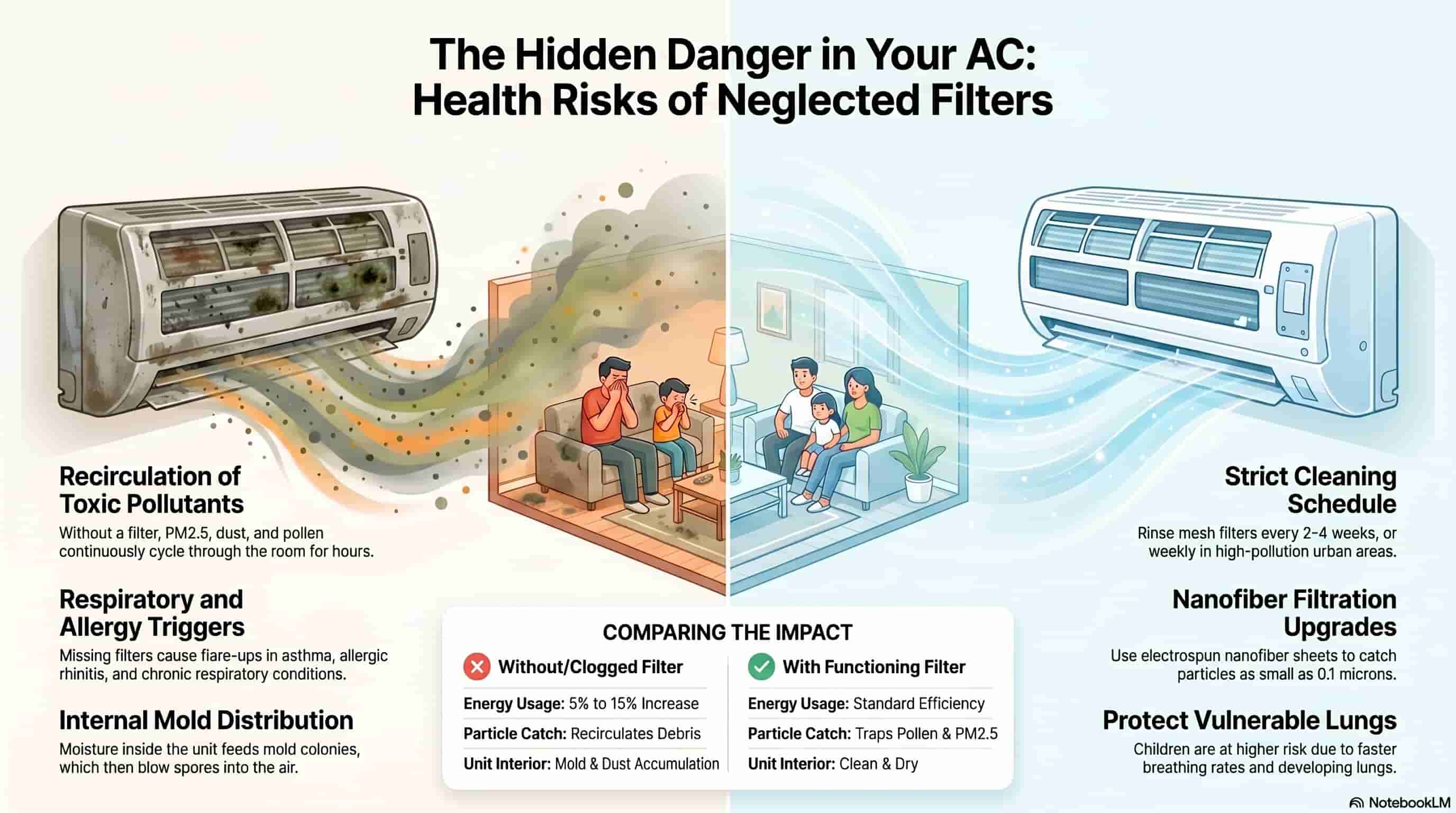
Dust accumulates on the evaporator coil. Cooling efficiency drops. The compressor runs longer cycles to compensate, putting mechanical stress on components that are not designed for that load. The air coming out of the unit carries more particulate matter, not less. Mold takes hold in the damp interior. Anyone with allergies starts noticing their symptoms flare indoors — the one place they assumed was safe.
Eventually, the lack of filtration shows up as a repair bill. Dirty coils, blocked drains, and overworked compressors are among the most common causes of AC breakdowns in India. Most of them trace back to inadequate filter maintenance.
According to real-time air quality data tracked by AQI.in — India’s national air quality monitoring platform — New Delhi ranks as the world’s most polluted city, with 92 out of the global top 100 most polluted cities located in India. In this context, letting your indoor AC filter fail is not a minor inconvenience. It is removing one of the few practical barriers between your family and the air outside.
How Often Should You Actually Be Cleaning It
Every two to four weeks during regular use. Every week if you live near a main road, a construction site, or in a city that regularly records AQI above 150 in winter — which, based on AQI.in data, covers most of urban India from October through February.
You can rinse basic mesh filters under running water, gently brush them, and let them dry completely before reinstalling them. Replace the filters once a year, or sooner if the mesh develops physical damage or permanent discolouration.
If you have upgraded to an advanced nanofiber or electrostatic filter sheet, do not wash it. The structure that makes these filters effective — the nanopore geometry and electrostatic charge — does not survive rinsing. Replace it on schedule, typically every one to two months depending on your local air quality.
Set a reminder on your phone. Tie it to your monthly electricity meter reading. Whatever works. The point is to make it a habit rather than something you remember only when something goes wrong.
The Prana Air Split AC Filter is built specifically for this problem.
It is made from electrospun nanofibers — a material thin enough to capture particles as small as 0.1 microns, including PM2.5, airborne bacteria, and fine viral particles, with very high filtration efficiency. It slides directly behind the existing mesh in your split AC — no tools, no technician, and no new appliance required. Installation takes less than five minutes and it is compatible with all major split AC brands and tonnages, including Voltas, Daikin, and LG.