 Gyane Haobijam
Air pollution is not static. Pollution levels can rise sharply within minutes due to traffic congestion, construction dust, industrial emissions, or sudden weather changes. In such a fast-changing environment, delayed air quality reports are no longer sufficient.
This is why real-time air quality monitoring is becoming essential for modern cities. Today’s advanced monitoring systems provide continuous, live data that allows governments, organizations, and individuals to make immediate, informed decisions. Instead of only measuring pollution, cities are now learning to actively manage the air they breathe.
What Is Real-Time Air Quality Monitoring?
Real-time air quality monitoring involves continuously measuring air pollutants and transmitting data instantly to cloud platforms, dashboards, and mobile applications. These systems track major pollutants such as:
-
PM2.5 and PM10 – Fine particles harmful to lungs and heart
-
Nitrogen dioxide (NO₂) – Mainly from vehicle emissions
-
Ozone (O₃) – A harmful ground-level pollutant
-
Carbon monoxide (CO) – A toxic gas from fuel combustion
-
Sulfur dioxide (SO₂) – Emitted by burning fossil fuels
The data is converted into live Air Quality Index (AQI) readings, enabling real-time awareness of air pollution levels.
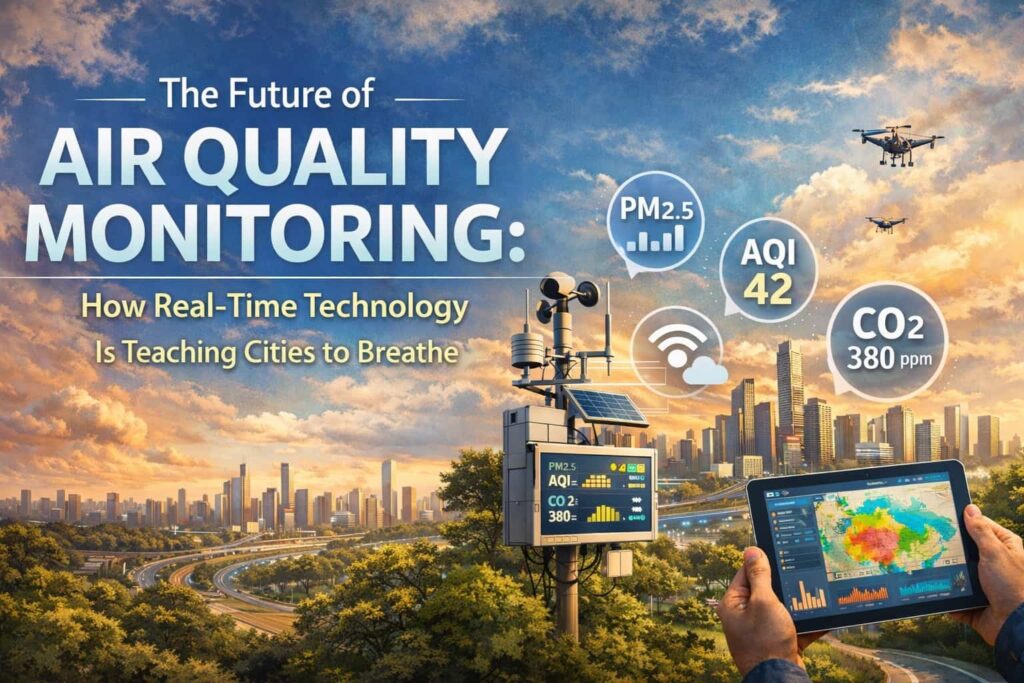
How Real-Time Air Quality Monitoring Works
Modern monitoring systems rely on a connected ecosystem of technologies working together seamlessly.
1. Smart IoT Air Quality Sensors
Compact and connected sensors are installed across urban areas on street infrastructure, buildings, and transportation networks. These devices continuously measure pollutants along with temperature and humidity.
2. Cloud-Based Data Platforms
Sensor readings are transmitted instantly to cloud servers, where the data is processed, validated, and visualized. This allows cities to access live dashboards and pollution maps.
3. AI and Data Analytics
Artificial intelligence analyzes patterns in real-time data to detect unusual pollution spikes, identify possible pollution sources, and predict short-term changes in air quality.
This integration transforms monitoring into a live environmental intelligence system.
Why Real-Time Monitoring Is Transforming Pollution Control
1. Immediate Response to Pollution Spikes
When pollution suddenly rises, real-time systems detect it instantly. Authorities can issue health advisories, regulate traffic, or investigate emission sources without delay.
2. Stronger Public Health Protection
Hospitals, schools, and offices can use live alerts to limit outdoor activities or enhance indoor air purification during high pollution periods.
3. Smarter Urban Operations
City administrators can use real-time data to manage traffic flow, enforce low-emission zones, and monitor industrial compliance in specific areas.
4. Informed Daily Choices for Citizens
Mobile applications connected to real-time monitoring systems allow people to decide when to exercise outdoors, when to wear protective masks, or when to stay indoors.
Real-Time Air Monitoring and Smart Cities
Smart cities depend on real-time data to function efficiently, and air quality monitoring is becoming a critical component of this ecosystem.
Live air quality data can integrate with:
-
Traffic management systems
-
Public transportation planning
-
Environmental command centers
-
Emergency response systems
If pollution increases in a specific area, traffic can be rerouted, alerts can be issued to nearby schools, and response teams can act quickly. Air monitoring is evolving into a city’s digital environmental nervous system.
Real-Time Indoor Air Quality Protection
Real-time monitoring is also transforming indoor environments. Smart buildings now use live indoor air quality data to maintain healthy spaces.
These systems can automatically:
-
Adjust ventilation rates
-
Activate air purifiers
-
Limit the intake of polluted outdoor air
Offices, schools, hospitals, and homes benefit from continuous air quality awareness, ensuring safer indoor air regardless of outdoor conditions.
Real-Time Data Enables Accurate Air Quality Forecasting
Continuous data collection improves the accuracy of short-term pollution forecasts. By combining real-time readings with weather data and historical patterns, AI systems can predict air quality levels hours or days in advance.
This allows:
-
Schools to plan outdoor schedules
-
Event organizers to manage gatherings
-
Healthcare systems to prepare for pollution-related health issues
Real-time monitoring forms the foundation of predictive air quality management.
The Future of Always-On Air Intelligence
The future of air quality monitoring is continuous, connected, and intelligent. Emerging innovations include:
-
Dense city-wide sensor networks
-
Integration with wearable health devices
-
Automated building responses to pollution
-
Centralized real-time environmental control centers
Air monitoring is shifting from periodic observation to constant protection.
Conclusion: Turning Data Into Cleaner Air
Air pollution is a fast-moving challenge, and managing it requires equally fast solutions. Real-time air quality monitoring provides the speed, accuracy, and insight needed to protect health and guide better urban decisions.
By combining smart sensors, cloud connectivity, and AI-powered analytics, cities are no longer just observing pollution — they are responding to it instantly. This marks a major step toward healthier communities and more livable cities.
Technology is not just tracking the air we breathe. It is helping cities learn how to breathe better.
 Shakshi